Fiberglass, Vinyl Liner or Gunite: Choosing a Pool Shell for a Central Kentucky Yard
Each pool shell has real strengths and real costs of ownership, and the right one depends more on your yard than on a brochure.
October 20, 2026 · 4 min read
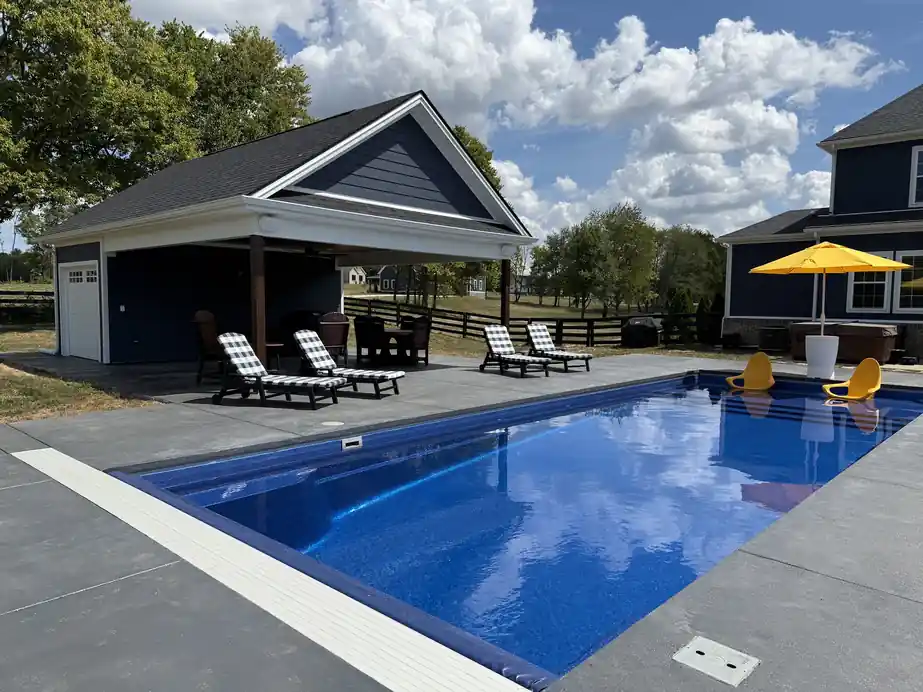
Sooner or later, every homeowner thinking about a new pool asks the same thing: which kind should I get? There isn't one right answer. There's a right answer for your yard, your family and how much upkeep you're willing to sign up for. Here's how the main inground choices really differ, so you can walk into the conversation knowing what to ask.
What kinds of pools can be built here?
American Pool & Spa installs fiberglass, vinyl liner, hybrid vinyl liner, custom gunite and Bio Design pools, along with Radiant above-ground pools. The company is a certified Latham Grand Dealer, which is why fiberglass models like the Aspen come up so often. Its projects page lists Aspen pools at 16 x 40 ft in Nicholasville and Frankfort, a RiverPools D40 at 16 x 40 ft in Midway, and a hybrid vinyl liner sports pool at 20 x 36 ft in Richmond. Same trade, very different builds.
Fiberglass: a one-piece shell with a smooth surface
A fiberglass pool is molded in a factory, trucked to your yard and lowered into the excavation in one piece. That's the main appeal. The shell shows up finished, so once the hole is dug and the base is prepared, the pool goes in far faster than one that has to be formed on site. The gelcoat surface is smooth, which gives algae less to grab and feels easy on bare feet.
The trade-off is shape and size. The shell has to travel down the road and fit through your site, so you choose from the models offered instead of drawing your own outline. Access matters too. Power lines, mature trees and a narrow gate can limit where a truck and crane can reach. A walk around the yard settles that question early.
Central Kentucky clay adds one more thing to watch. Clay holds water, and a shell needs a well-prepared base and careful backfill around it. That's work for an experienced installer, not a rushed crew.
Vinyl liner and hybrid vinyl liner: the shape-flexible option
A vinyl liner pool uses a sheet of vinyl, cut to fit, stretched over a framed wall and base. Because the structure is built on site, the footprint is flexible. That's how a 20 x 36 ft sports pool, or a 20 x 40 ft pool with a 7 x 10 ft bump out, ends up on the American Pool & Spa project list. If you want a long rectangle for laps, a wide shallow area for kids or an odd corner to fill, a liner pool gives you room to draw.
The catch is that the liner is a surface, not structure, and surfaces wear. Sharp objects, sun, and big swings in water chemistry all take a toll, and eventually a liner gets replaced. That's routine work. Liner and membrane replacement sits on the company's pool rehab list. Owners can help by keeping the water balanced and never letting the level sit low, because a liner that dries out can shrink and pull.
- Which wall system and base is my pool built on?
- How is the liner fitted around steps, corners and any bump out?
- What does a liner replacement involve down the road?
- How does the pool behave when the ground is soaked after a wet spring?
Gunite: any shape, more building time
Gunite is concrete sprayed over a steel rebar cage that's shaped on site, then finished with plaster or another interior surface. It's the most flexible choice for shape and depth, and it handles things like raised walls, benches, tanning ledges and unusual curves. It's also the most hands-on build. There's forming, spraying, curing and then the interior finish, so expect more steps and more time than setting a shell.
The surface is rougher than fiberglass and it reacts to water chemistry. Plaster likes steady balance, because low pH or soft water can etch it and high calcium can leave scale. It can be replastered later, which is the gunite side of pool rehab. Plenty of people take on the upkeep happily for the freedom of a truly custom design.
Which one fits a Central Kentucky yard?
Start with the weather. This part of the state swings from hard freezes to hot, humid stretches in the same year, and every pool has to live through both. Fiberglass flexes a little with the ground. Gunite is rigid and relies on its steel and structure. A liner is flexible but cares a lot about water level. None of them is fragile, but each has its own habits.
Then look at the dirt. Clay, rock and slope all change the dig, the base and the drainage, and a site visit tells you more than any picture can. Ask your installer to check access, where water runs during a heavy rain and what's underground before anyone talks about a final design.
- Fiberglass: quickest to install, smooth surface, set model shapes and sizes.
- Vinyl liner and hybrid vinyl liner: flexible footprints, replaceable surface, water level matters.
- Gunite: any shape and depth, longest build, plaster needs steady chemistry.
- Above-ground and semi-in-ground: a lower-commitment way in, with Radiant above-ground pools on the menu.
If you're weighing these options, the /pools page lays out the pool types the company builds, and the best next step is to talk it through in person. American Pool & Spa is at 265 N Keeneland Dr, Suite 1, in Richmond, open Monday through Friday, 10am to 5pm. Call (859) 623-0124 and bring your lot, your questions and your wish list.
American Pool & Spa, 859.623.0124
Call 859.623.0124More articles
What a Spring Pool Opening Involves, and When to Book It
An opening is more than pulling the cover, and getting the timing right keeps a green pool from becoming your first project of summer.
Closing a Pool Before a Kentucky Winter
A good closing protects the plumbing, the equipment and the cover, so your spring opening is a routine job instead of a repair list.